
By Mahima Rai
This article contains discussions of death, gun violence, government violence towards civilians, sexual harassment and assault, and misogyny.
In early September 2025, the digital thread that stitched our connection to Nepal was cut off. Social media (Instagram, Facebook, WhatsApp), among others, were banned overnight by one of the old men in government. Oli, Deuba, Prachanda—what does the name matter? They are interchangeable. Over the last 19 years, since the civil war ended, they have morphed into one entity. Just different masks.
They said it was a failure to register these apps through proper channels. It was a blatant ruse and an official lie. But the ban was ripple hiding the quake. It was no isolated ripple, brewing below the surface tremor lay decades of suffocation: youth unemployment, governance failures, and viral exposés of ‘nepo kids’, politician’s children and grandchildren flaunting luxury abroad on TikTok and Instagram under #nepobaby[1].
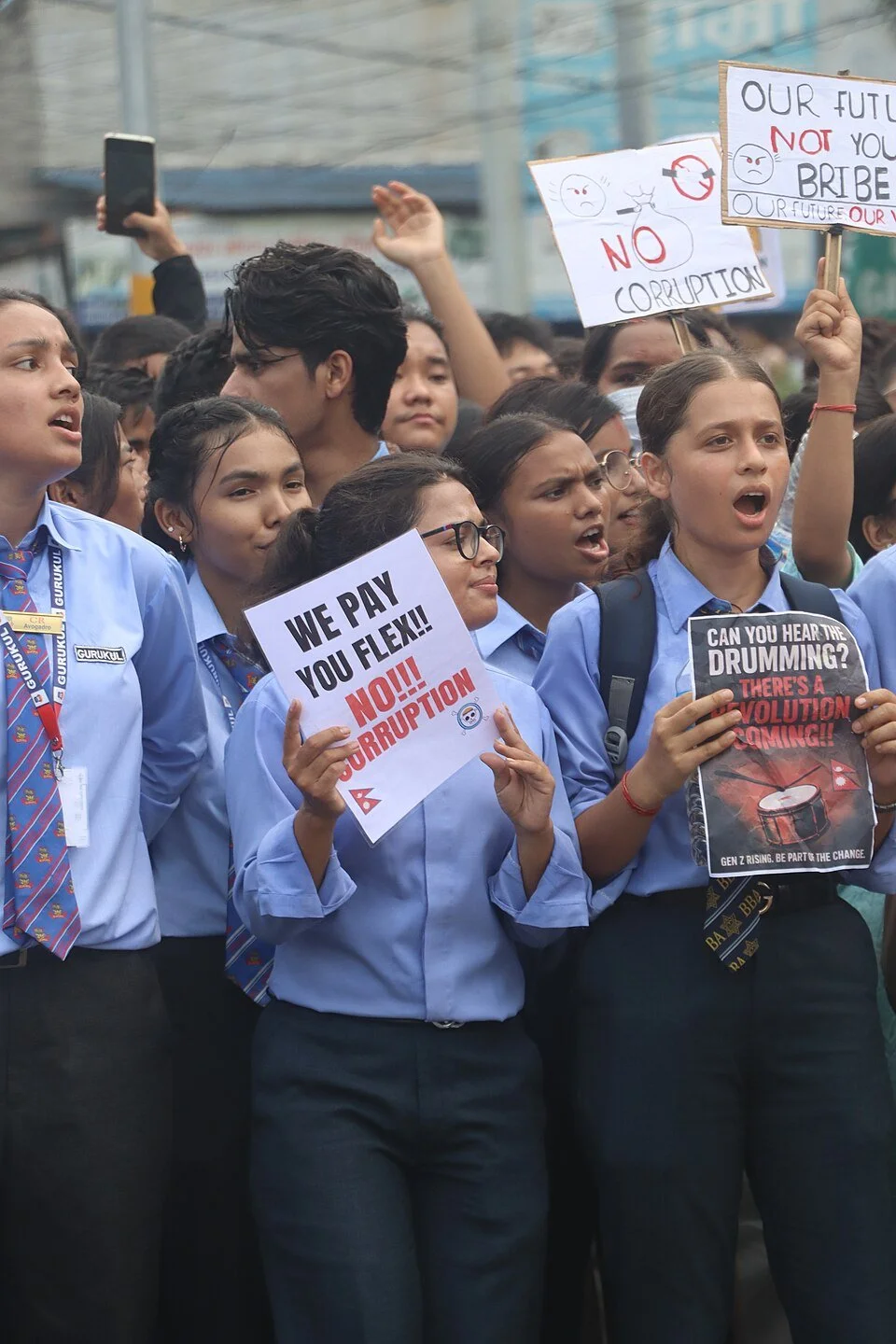
In response, a leaderless network of students called for a protest. It was coordinated through alternative digital channels like Discord and united by frustration over corruption and censorship. My father-in-law shared the invite with a joke about his age, saying he wouldn't qualify to participate. I, cocooned far away in my European flat, spoke of critical mass and urged him to go. I did not speak of minors in school uniforms. I did not speak of bullets.
The next day, they killed nineteen young people. Nineteen.
One protester was as young as 14. A child who should be worrying about algebra homework, not autocracy.
The Prime Minister wagged his finger at the broken windows and focused on the ‘infiltrators’, ‘vested interest groups’, and external forces for escalating violence, property damage, and deaths, denying personal fault or crackdown orders. Choosing to focus on the tremors, rather than why the earthquake took place. He chose to ignore our suffocation. You and I—we know the architecture of this suffocation. We wriggled out of this chamber. But in our escape, we caught a strange amnesia. We forgot the cruel dimensions of this room and how it feels to barely breathe.
Had we stayed, our bodies would now be part of that demonstration. We would be forced to watch in real time the children of our politicians perform their luxury on the very platforms we are denied.
HUNE KHANE/NA-HUNE KHANE—THE HAVEs and HAVENOTs
Life in Nepal is one of relentless arithmetic the calculation of gadi-bhada, fare for public transportation, against the emptiness of a goji, pocket. It means struggling through an educational system that rewards mimicry and punishes thought. A system where one month's fee at a private school equals a teacher's annual salary. For decades, the solution for the young has been a single verb: bideshine, to go abroad. We are its perfect specimens.
But for those who want to remain in Nepal, or who can't afford to leave, the project of building a self without capital or connection is a steep, almost impossible climb.
A certificate from an English-medium school yields a job, not a life. If you don't live with your parents, a single room serves as your kitchen, living room, bedroom, and cell. Your existence is defined by absences: of water, of power, of clean air to breathe. All this is endured in the hope of better pay, which demands unpaid hours, the sacrifice of your body, and the inhalation of the city's powdered decay.
And if your body is not able, not cis, not male, not high-caste, the state and the street conspire to add further weight. The infrastructure of public life becomes an assault course designed for your failure. The commute is a gauntlet of groping hands, your skin color—a subject of negotiation, your very shape—a provocation.
THOUGHT EXPERIMENT
Let me make this concrete. Let us perform a thought experiment, let us imagine the life in which I did not escape.
Imagine me on my way back home from work. The series of microbuses are jam-packed with men with groping hands and vile intent. They casually press into my backside, my front, and my sides. I am late because I was finishing a presentation. This job is my only means of avoiding the threat made by our parents to either succeed or get married. I am 34. My unmarried state is a communal pathology. Our uncles find a sliver of value in the lightness of my skin, a potential discount on the dowry, a hedge against future abuse.
Despite all this, I won a scholarship. Now I live in the city. The civil war has been over for 19 years, but I am reminded of where I am when a hand not so subtly squeezes my side. Are things really better now? I pinch that body back silently and pray for the van ride to end soon. I hurry to my 12 sq. m room that I call home in the city. By the time I unlock the door, I am exhausted and starving. My skin crawls with the memory of grubby hands, stinking breath, and sour armpits. At least, I didn’t have to wait who-knows-how-long for the night bus to take me home. As you very well know, buses don’t run in schedules here. No one knows when the next one will come, nor when the last bus of the night will be. Aafno gadi, car ownership, is out of question for my aaukat, status. Cars, like high-paying jobs, are reserved for the hune-khane, the Haves. I am clearly nahune-nakhane, a HaveNot. My aukat, is that of gadi-bhada tirne, public transport user, not, aafno gadi hune, car owner.
I want comfort, but the family telephone line is a conduit for blame. The fault, they will say, is mine. The logic of the patriarch is infallible: I was the one who was 'out too late'. My kurtha, top, was askew; it 'enticed'. The men were otherwise 'harmless'.
I am starving. I want to heat the leftovers. I flip the switch.
Andhakar. Darkness.
Power cut. The emergency light is dead. I find a candle stump. The act of lighting it consumes the last of my energy. The food will remain cold. I lie down. I unlock my phone.
The algorithm shows me the other Nepal. The other Nepalis.
A politician’s grandson before a grand tower of Louis Vuitton boxes.
A politician’s daughter, adrift on a yacht surrounded by sparkling wine on a sea of privilege.
I contemplate their lives.
While I sleep hungry, they are at play. Their playground is built with the tax money deducted from the salary I work to earn. The salary that sustains our family and educates our cousins. I have seen a photograph of the anti-corruption minister's house. It is a palace fit for a god. It feels like a slap to my face.
Will I ever flip a switch without bracing for darkness, or does 24/7 electricity remain a slogan?
Will the college certificate our family drowned in debt to earn ever be more than a receipt for a dream that was sold to us, but never delivered?
“Will my children inherit a country, or just a longer, more desperate application form to leave it?”
Will the state ever see me as a citizen to be served, or only as a source of tax to be extracted and a vote to be manipulated?
When the Koshi river swells again this monsoon, will it flood away the thousands of livelihoods once more, or has the state finally built the dams it has promised for generations?
Will my children inherit a country, or just a longer, more desperate application form to leave it?
Will all this struggle ever feel meaningful, or simply the toll I pay for the circumstances of my birth and place? A price that doubles or triples if you are not born hune-khane, not cis, not male, not upper-caste, not able-bodied. I am utterly exhausted.
On my best days, I am alive. On my worst, I merely exist. To thrive is a condition reserved only for the Hune-Khane and those favored by able-bodied patriarchs in Nepal.
BALI KI BAKRI—THE SCAPEGOAT
Then the state bans the platform. My life, already suspended, grinds to a halt. I cannot signal my safety to our parents. This digital space, for all its poison, was a square foot of public space I occupied, rent-free. Snatching that was the final straw. So, I join the protest. For a moment, I am not a noun. I am verb. It feels cathartic. A man steps down. A woman steps forward. I feel a dangerous, fluttering thing: hope.
The ban lifts. I return online. A former Miss Nepal is trending and has become the face of #nepobaby. She is beautiful, rich, married to power. She is the perfect scapegoat.
Why her, though? Having walked a mile in my skin, you might already guess.
First, she is well-known in Nepal and beyond. Her fame makes her legible in a way other, more obscure beneficiaries are not.
Second, and more insidious: she is a woman. Many might say, ‘No, no, no. We treat out women with respect! Everyone is treated equally.’ But, having walked in my shoes, you’ve started to see the patterns.
She has been blamed before. Back then, she chose to stay silent. It could be debated whether that was her choice or the result of being socialised as a woman. The public interpreted her silence as a crime and pressed for answers, which pushed her into a reactionary corner. This time, she finally spoke out. But speaking seems to have been a mistake, too. When she spoke, she lost the fragile shield of perceived innocence. The hate intensified. Her story now serves a larger, cynical purpose: it pushes the algorithm away from the crimes of men, from corruption, from the burning parliament.
In contrast, the men in her story, the former partner, the current husband, are granted the privilege of error. Their mistakes are temporary. Their rehabilitation is assumed. The patriarchy is a system of conditional pardons for men and perpetual probation for women.
Can you see the grand engineering? For a woman, life is a labyrinth where the walls are made of other people's expectations. Every breath is policed. And we do it without even being conscious of doing it. You, me, her, him, them—all of us.
Yes, women do it, too. It is the misogynistic system reproducing itself. We have all internalised the logic that men are superior. That is why we see women rising to defend the very men who orchestrate their oppression. This is the final, perfect triumph of the system: to make the victim an agent of her own subjugation.
This is what we are up against.
HOW TO BE A SYSTEM DESTABILISER
Systems are not as strong as they seem. They are maintained by those who benefit from them. Their greatest fear? Those who destabilise them. That is why the Gen Z Revolution scared a lot of hune-khane because they benefit from the current systems in place.
You don’t need to know system theory to be a destabiliser. It also does not have to mean being out on the streets protesting or writing a position paper and lobbying.
System destabilisation could also look like the next time an uncle jokes about a woman's role, you choose not to laugh but to speak up. It is in the moment you take to question whether it's really true that the woman is to blame for a man's mistake. It could be in the way you listen to women in our circles of friends, family, and beyond. Listen to their frustrations and ambitions, not to solve their problems, but to validate their lived realities. This is the daily, unglamorous work of dismantling our misinformed upbringing. Interrogate your own instincts and critically complicate the system you were brought up in.
You can refuse to be a brick in its wall.
This personal work is a seed. It must be planted in the collective soil of the political. It is a reciprocal relationship. If you want to see larger change, address and accept that you are part of the political. No matter your involvement in politics, or lack thereof, not saying anything is also saying something. Because the system is upheld by power, and it must be challenged with power.
Start by talking with your friends. Reflect with them on what power means to you and where you stand in relation to it. What are your privileges in that position? Urge others to share. How can you use your privilege for someone else's welfare? Then, step outside your comfort zone. Don't let differences in opinion keep you from connecting.
Reflect. Rest. Share. Rest. Argue. Rest. Agitate. Rest. Repeat.
And when the time comes, vote. This March 2026, let your ballot be your brickbat. Encourage others to vote, too. Our voice, our perspective, our remittances that keep this country afloat; they must now be followed by our political will. Register. Make your presence count. We escaped the physical suffocation, but we did not escape our responsibility to those who still breathe that air.
Are you with me?
Your sister, who re-remembers the dimensions of the suffocating space,
Nana, Older sister in Kirati language
Find out how to vote here: Vote for Nepal (votefornepal.org/how-to-vote)
Got a feminist opinion you want to share? We want to publish your work! Anyone can contribute to the GJP blog, no experience necessary! Find out more about being featured on our blog.
[1] See ‘The 2025 Genz Uprising in Nepal: A Three-Part Analysis’ by Sumina Suwal
Header image: by हिमाल सुवेदी via Creative Commons CC0 1.0 Universal Public Domain Dedication