
By Ishita Sharma
This article contains discussion of death and disability arising from corporate behaviour, medical and legal misogyny, and references to miscarriage and stillbirth.
Background
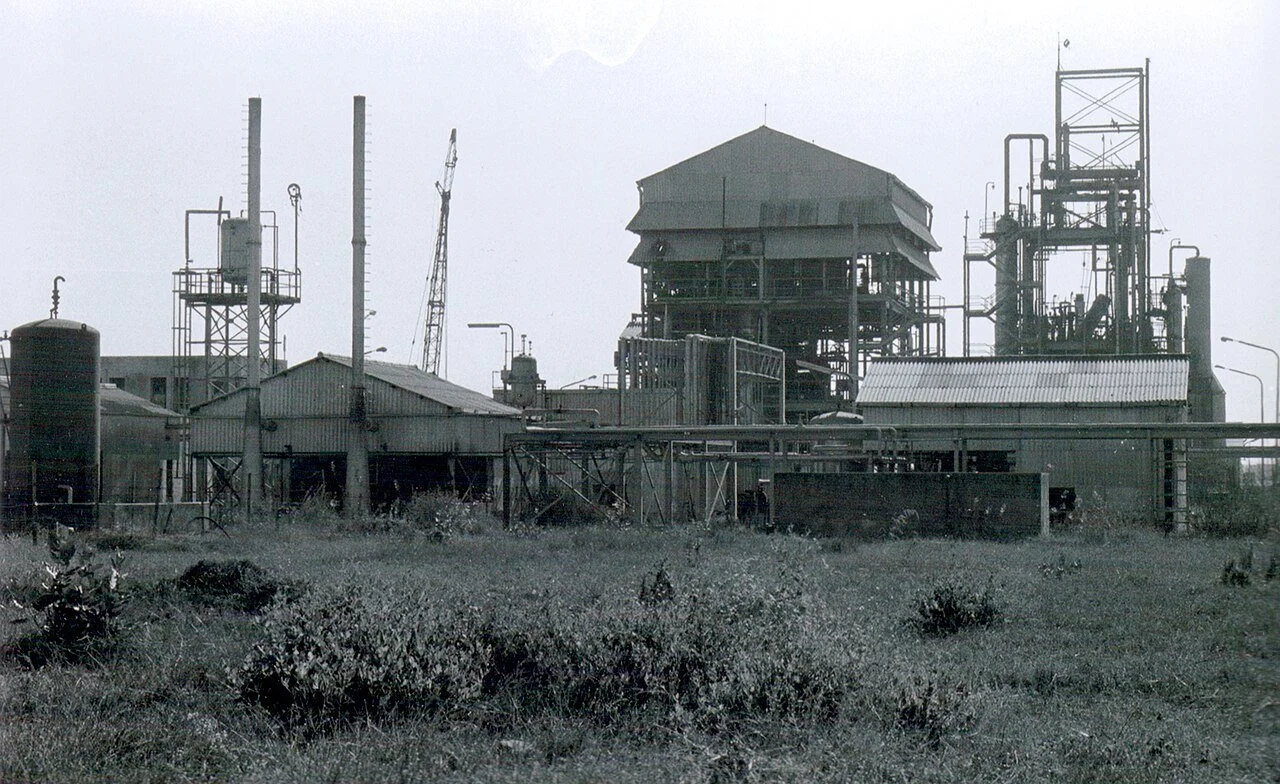
On the night of 2–3 December 1984, Bhopal witnessed one of the worst industrial disasters in history when lethal methyl isocyanate gas leaked from Union Carbide’s pesticide plant. The toxic cloud killed thousands within days and left hundreds of thousands with lifelong respiratory illnesses, reproductive disorders, and intergenerational health complications, while also contaminating Bhopal’s soil and groundwater with effects that still persist across generations. For women in particular, the tragedy was not only a matter of immediate injury but of miscarriages, infertility, chronic disease, and the long-term burden of caregiving in households plagued by death and disability.
Indian courts responded to Bhopal by developing new doctrines of liability and settlement but these came at the cost of erasing gendered harms. ‘The victim’ was imagined as a generic, disembodied subject, detached from the specific ways women experienced loss. This piece inquires whether Indian environmental law after Bhopal tragedy adequately recognises women-specific gendered harms. By examining the Bhopal Gas Leak Disaster (Registration and Processing of Claims) Scheme, 1985 and the Charan Lal Sahu v. Union of India judgment of 1990, this article argues that while Bhopal shaped the trajectory of Indian environmental law, it simultaneously exposed the structural blindness of the law towards women’s lived realities. To explore this, Silvia Federici’s Marxist feminist critique of reproductive labour is also relied upon in this essay.
Medical and Intergenerational Harms
Women’s bodies became some of the most enduring sites of Bhopal’s toxic aftermath. Medical research has traced a plethora of reproductive harms: miscarriages, neonatal and perinatal deaths, irregular menstruation, and increased pregnancy loss. Long-term studies also found genotoxic effects such as chromosomal abnormalities, with consequences spilling over the next generation in the form of congenital deformities, immune disorders, and developmental disabilities. One of the earliest toxicological studies revealed that nearly half of all those pregnant on the night of the disaster did not give birth to live babies, emphasising the scale of reproductive as well as emotional loss. A 2002 national fact-finding mission detected lead, mercury, and organochlorines in the breast milk of nursing mothers, noting that such hydrophobic chemicals cannot be expelled, except through the placenta or breast milk. Therefore, these women were forced to carry and transmit the disaster within their own bodies, making them not only survivors but unwilling conduits of intergenerational harm.
Social Harms and Caregiving Harms
The effects of the Bhopal tragedy on women were profoundly social as well. In a culture where a woman's value was correlated with motherhood, infertility and reproductive loss were highly stigmatised. Infertile women were seen as ‘bad omens’, and this notion was cruelly evident following the leak. Many women who could no longer conceive were abandoned or divorced by their husbands; their social standing destroyed just as their health had been. Others faced rejection in marriage because families did not want to wed their sons to the victims of the tragedy. Yet the same women, who were themselves ill, were also expected to take on extra care work: raising orphaned children, nursing sick husbands, and managing households where every member was injured or ill. This put women in a terrible situation where they were overworked as caregivers and yet denied recognition as mothers.
Rehabilitation after the gas leak reveals how disasters can harden existing social hierarchies instead of undoing them. Women were rarely treated as independent claimants for compensation, but as appendages of male claimants within the family unit (the basic category around which relief was distributed). This framework pushed women into a secondary role, made conspicuous by their absence from most official documents.
Beginning in 1985, the state set up 50 training and production centres, with the purpose of economic rehabilitation for gas-affected women to teach sewing, hosiery embroidery, and stationery manufacture, with a meagre stipend. Within four years, all but two centres had closed. Even when schemes targeted women directly, they reinforced stereotypes of passivity and sacrifice, tightening their dependence on state structures rather than empowering them. The result being gender was seldom treated as an axis of justice in itself and instead was blurred into an abstract notion of ‘rehabilitation’ that erased women’s distinct experiences.
Settlement and the Invisibility of Reproductive Labour
A USD 470 million settlement between Union Carbide and the Union of India was approved by the Supreme Court in February 1989. The Court justified this amount based on ‘rough and ready estimates’ that placed the death toll at about 3000 and the number of serious injuries at 30 000. As a result, the foundation of compensation was built upon figures that were not only contested but also drastically understated. Later discoveries suggested the true death toll was over 15 000 and that over half a million people were injured. The actual scale of women’s reproductive and social losses was far greater than what the Court acknowledged.
Compensation was then structured through a rigid classification scheme, which divided losses into heads such as death, varying degrees of disability, property and business loss, environmental damage, and government expenditure. This bureaucratic taxonomy may have created administrative order, but it also subsumed complex lived experiences, especially women’s reproductive, gynaecological, and social harms into narrow and inadequate legal boxes. As Federici argues, the conversion of women’s reproductive labour into ‘love’, ‘sacrifice’, or private duty is a classic move of capitalist governance: it naturalises injury and care, keeps them unpaid and invisible, and blocks women’s claims to autonomy and compensation. Through her lens, this compensation scheme operates like a valuation machine that erases reproductive labour, keeping the costs of social reproduction off the books and on women’s bodies. Drawing on Marxist feminist accounts of social reproduction, such as Vogel’s, this labour can be understood as the everyday work of sustaining life and the workforce over time – biological reproduction, childcare, domestic work, and the daily maintenance of bodies and households.
In Charan Lal Sahu v. Union of India (1990), the Supreme Court upheld the constitutional validity of the Bhopal Claims Act, which vested all claims in the Union under its parens patriae power (a common law doctrine that gives the State the power to act as a guardian for those who cannot care for themselves, such as children and vulnerable adults). Survivors were said to be ‘meek’ and ‘disabled’, a framing that erased their agency. Feminist scholars argue this recreated patriarchal authority: just as the family patriarch claims to know what is best, the State usurped the power to speak from survivors and in doing so, silenced them. By legitimising this paternal model, the Court reinforced the very discourse of victimhood it claimed to solve and protect. Yet survivors, including women’s groups, were active in organising for health, legal, and environmental justice. Had the Court restored their legal standing, representative suits could have deepened democracy by making the State support rather than replace citizen initiatives.
Reproductive Labour as the Hidden Subsidy
Indian government and Union Carbide settled claims at a low figure because they could rely on women to pick up the slack. Women’s unpaid care, tending to disabled husbands, raising orphaned children, and managing chronically ill family members effectively became a substitute welfare system. Federici’s argument, that reproductive labour is capitalism’s hidden subsidy, translates perfectly here: the state could externalise the real costs of rehabilitation, knowing that women’s ‘natural’ caregiving would absorb them without wages, recognition, or compensation.
This blindness was not incidental but systemic. The law has historically treated reproductive labour as outside the sphere of ‘work’, even though it is central to survival. For instance, most labour and wage statutes exclude housework and caregiving from definitions of employment. Compensation frameworks rarely acknowledge domestic or caregiving losses and wrongful death and injury laws typically quantify damages in terms of lost wages, not unpaid care. Divorce and family law regimes often treat women’s household labour as a matter of moral duty rather than economic contribution, with property division rarely recognising it as a financial asset.
Conclusion
Post-Bhopal law, especially the compensation scheme and Charan Lal Sahu v. Union of India, erased women’s distinct harms and relied on paternal state power while quietly offloading rehabilitation onto women’s unpaid care. Justice requires recognising and compensating reproductive labour within the legal framework.
Unless reproductive labour is recognised and protected, legal systems will remain structurally incapable of addressing gendered harms. Bhopal teaches one urgent lesson: justice cannot stop at compensation. It must also demand that the law itself be rewritten to value reproductive labour as the foundation of both survival and justice.
Editor’s note: This article uses the term ‘women’ to refer to those who experienced gynaecological and gendered social harms as a result of the Bhopal gas tragedy as this was the primary group impacted, studied, and targeted by government rehabilitation centres. Gender Justice Project acknowledges that these harms also extended to some gender diverse people. We strongly support liberation from patriarchal structures for all.
Got a feminist opinion you want to share? We want to publish your work! Anyone can contribute to the GJP blog, no experience necessary! Find out more about being featured on our blog.
Header image: By Bhopal Medical Appeal, Martin Stott - https://www.flickr.com/photos/44868727@N02/14119398488/, CC BY-SA 2.0, https://commons.wikimedia.org/w/index.php?curid=116734056